NEED HELP
+92 326 0334630
+923090549911
+923090549911

WHAT ARE YOU LOOKING FOR?
QUICK LINKs
Login
No account yet? Create an account
Register
Have an Account. Login

Launch or grow your clothing brand with end-to-end manufacturing, printing, stitching, and packaging all under one roof.
Welcome to your all-in-one textile solution provider. Whether you’re launching a new clothing brand or scaling an existing one, we offer comprehensive services: fabric sourcing, textile printing, embroidery, stitching, packaging, private labeling, and more. We handle every detail so you can focus on building your brand.
At UTM Corporation, we believe in empowering clothing brands from their very first sketch to the final packaged product ready for sale. Our journey began with a vision: to provide a seamless production pipeline for brands, eliminating the hassle of coordinating multiple vendors.
We combine decades of textile experience with modern manufacturing, printing, embroidery, and packaging technology to deliver high-quality, consistent results. Our team of skilled craftsmen, technicians, and design specialists works closely with every client, whether a new startup or an established brand, to fulfill custom requirements with precision and care.
Our mission is simple: to be your trusted manufacturing partner in clothing. We aim to make brand development easier, faster, and more reliable, so you can focus on creativity, design, and growth.
We offer a full range of services tailored to clothing brands. Whether you need a single service or full-scale end-to-end production, we’ve got you covered.
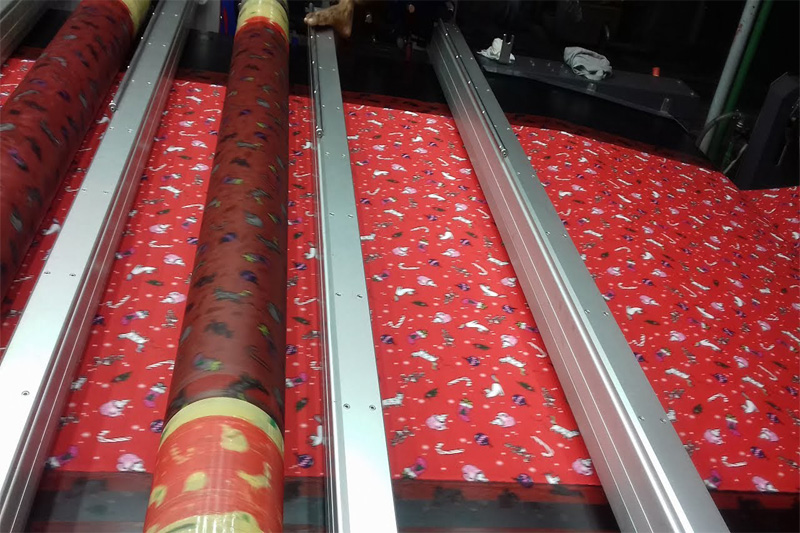
The basic operations of rotary and flat printing machines are very similar. Both use the same type of infeed device, glue trough, rotating blanket or print table, dryer, and fixation equipment.
The first step in rotary printing is feeding the fabric onto a rubber blanket. The fabric then travels under the rotary screens one screen for every color in the design. The screens rotate as the fabric passes underneath. Print paste is continuously fed to the interior of the screen through a color bar or pipe. As the screen rotates, the squeegee device pushes print paste through the design areas of the screen onto the fabric.
Rotary screen machines are more compact than flat screen machines, therefore they use less plant floor space. The size of the design repeat is dependent upon the circumference of the rotary screen. This was initially seen as a disadvantage because the first rotary screens were small in diameter. Today’s screens are available in a wide range of sizes.
Modern rotary screen machines are highly productive. They have few design limitations and can be used for both continuous and discontinuous patterns. It is estimated that approximately 65% of the worldwide printed fabric market utilizes the rotary screen technique.
The principal disadvantage of rotary screen printing is the high cost of the equipment. Rotary screen printing is generally not profitable for printing small orders because of the time required to change screens and perform the necessary cleaning operations.
Sign up to receive information about new arrivals and special promotions.
Pakistan
silkotextiles@gmail.com
+92 4235113341
+92 4235118064